RACHEL CARSON

RACHEL CARSON

SPACESHIP EARTH

"We travel together, passengers on a little spaceship, dependent upon its vulnerable reserves of air and soil, all committed for our safety to its security and peace; preserved from annihilation only by the care, the work, and, I will say, the love we give our fragile craft. We cannot maintain it half fortunate, half miserable, half confident, half despairing, half slave to the ancient enemies of man, half free in a liberation of resources undreamed of until this day. No craft, no crew can travel safely with such vast contradictions. On their resolution depends the survival of us all."

ADLAI STEVENSON, 1964

Friday, May 6, 2011

CHEMTRAILS aka "STRATOSPHERIC AEROSOL GEOENGINEERING"


http://geo-terrorism.blogspot.com/2011/05/chemtrails.html

The Consequences of Toxic Metals and Chemical Aerosols on Human Health

"Even with the increases in preventable illnesses, the issue that has not been linked or addressed –with what Clifford Carnicom rightly calls “aerosol crimes”– is the deterioration of cognitive function...
it is obvious –to anyone who is paying attention– that many people are behaving oddly. While it may be considered “anecdotal” reporting, there are millions of people whose behavior is strange. There have been numerous times in just the past year when I have asked someone a question and received an answer that is totally unrelated. There have been more and more uncontrolled outbursts in public areas: someone “snaps” for no apparent reason. Violence levels are up."

Part I

By Dr. Ilya Sandra Perlingieri

www.globalresearch.ca/index.php?context=va&aid=19047

Global Research, May 12, 2010

For decades, we have known that heavy metals and chemicals can cause grave physical harm. Going back to Rachel Carson’s Silent Spring, we have known and been amply warned of the serious consequences of using or being exposed to these poisons in our daily activities. Thousands of these are well-documented carcinogens.

Building on Carson’s ground-breaking research, we also know that certain kinds of chemicals can and do disrupt human [and other animals’] entire immune system. Going back 30 years, researchers were investigating what became known as endocrine [hormone] disrupting chemicals and how they were affecting frogs [who sometimes had five legs or hermaphroditic characteristics], other aquatic animals, and mammals. These animals were the proverbial canaries in the coal mine. In another pioneering book, Our Stolen Future authors Dr. Theo Colburn, Dianne Dumanoski, and John Peterson Myers clearly demonstrate that 1 + 1 hormone-disrupting chemicals did not equal 2. Rather, in a nightmare of mathematical proportions, these poisons acted synergistically; and 1+1 could equal up to 1,600 times the original dose. We are also exposed to more than 100,000 chemicals regularly. Most of them have never been tested for human safety. So, almost nothing has been done to reduce human exposure to a myriad of hazardous chemicals. In fact, over the past decade, the Bush administration dismantled many environmental laws in existence for 30 years, to let corporations off the proverbial hook. [Just look at what’s unfolding in the Gulf with the BP oil spill.]

[SEE URL FOR ENTIRE ARTICLE]

ALSO POSTED AT

http://geo-terrorism.blogspot.com/2011/05/chemtrails.html

Sunday, March 20, 2011

"MESSAGE FROM THE EARTH" MOUNT TITIROA NEW ZEALAND


"We as human beings are only one species of life on a planet who is home to billions of life-forms, known and unknown. All life forms are unique; in the most fundamental ways we are no different or important than any other living being, except that our beliefs about ourselves have set us apart in our own minds, in thought and in action, and in the ability of our technological-industrial civilization to poison and exploit the planetary biosphere. Dominant belief paradigms like Darwinism and Judaeo-Christianity have laid the foundation for the widespread separation from and destruction of the natural world which we now experience and exacerbate. Indigenous peoples who live simply and in touch with nature are systematically decimated; their lands stolen, resources extracted, and the remnants become assimilated into the modern “way of life” centered on materialism, over-consumption, and the religion of capitalism. In the words of Joseph Wood Krutch,

“Man is one of those animals which is in danger from its too successul participation in the struggle for existence…from the standpoint of nature as a whole, he is both a threat to every other living thing, and therefore, a threat to himself also…he has become the tyrant of the Earth, the waster of its resources, the creator of the most prodigious imbalance in the natural order which has ever existed…”

We as human beings require the Earth for our existence; the Earth loves us as one of her children but does not require our existence. As we poison and destroy the Earth, we literally do this to ourselves. Our “artificial realities” imposed on the Earth and each other have supplanted our relationship with the natural world to such an extent that nature is no longer a primary element of consciousness.

One in two people globally now live in cities. No city of any size can possibly be a healthful place to live. Cities are high-density concentrations of all the most destructive things that people do, and are permeated with high levels of toxins, electromagnetic radiation, noise and socio-cultural malaise. People living in cities are far more vulnerable to natural and man-made disasters than people living in more natural and de-centralized conditions in the country or forest.

The Earth is a constantly changing and dynamic being, a living planet undergoing transformations just as her life-forms do; the Earth simultaneously provides an encompassing context for life as we know it, but is also itself embedded in larger cosmic contexts, most notably, the heliocosm, or local solar system, which is itself dynamic, transformative, and influenced by energies and movements at the galactic level.

Current science tells us that life itself has survived several “mass extinction events”; 99.9% of all life-forms that ever existed are now extinct. Life is not so much a specific life-form, for example, an individual organism or species, but more of a process.

Human life has been around long enough to have witnessed cosmic catastrophes that have left imprints in our collective psyche. The Earth experiences cyclical variations that result in changes in climate and magnetic fields, with resultant effects on life-forms.

Ancient/indigenous cultures have knowledge of some of these cycles and have long predicted the accelerated “Earth changes” now upon us. The influence of the existence of our global technological-industrial civilization is a significant factor as well in how these Earth changes affect us and the planet. The choices that we make, individually and collectively, on how we live and what we do with respect to the Earth also comprise a significant factor in the overall equation.

In addition to the direct manipulative and destructive effects of our technological civilization, including man’s warfare against himself, we may also be precipitating a higher degree of negative influence from the cosmic levels due to the disruption of natural systems at a planetary level. These negative influences could be termed “karmic” as well as “energetic” and “morphogenetic.”

At the human level, our overall desensitisation to the vibrations of nature puts us in a frequency domain out of harmony with the Earth and out of harmony with the incoming energetic shifts. Our decision-making is affected and in general we are not living in ways that are compatible with the long-term health or even existence of life as we know it, human or non-human. When we are out of touch with the subtle intelligence of nature, we are not able to respond to urgent warning signals, psychic “alarm bells” which may alert us to impending danger. When the local environment is saturated with electromagnetic radiation and chemical toxins, our personal auras are distorted, our resonance with the Earth’s magnetic field is blocked and we are out of synch with the real world in which life as we know it has always lived and evolved.

The Earth is not “punishing” us for doing what we are doing; we are punishing ourselves, and the Earth. The result is that we are making it vastly more difficult for ourselves to make it through this window of time successfully, for example, by continuing to live more and more extravagantly, consuming more and more resources, instead of pulling back on our damage to the Earth like indigenous elders and true “old school” environmental leaders have been telling us to for decades. In no way are we using our best or highest knowledge; the opposite is closer to the truth, as we plunge head-long into accelerating destructive habits and the refusal to renavigate our course to oblivion.

In the aftermath of the development of atomic weapons, Albert Einstein observed that “everything has changed except our ways of thinking.” This same insight can be applied to the effects of our entire military-industrial civilization: science-fiction level technologies are being deployed of on an undreamed-of scale, yet as individuals we cling to totally out-moded beliefs and values that make no sense in today’s world. We each are affected daily by the results of the scientific “revolution” yet most people could be classed as scientifically illiterate.

The unknowns with which we as humans are now confronted are enormous. The biggest unknowns lie within each of us, the mystery of why, for example, we steadfastly refuse to wake up out of the hypnotic trance called “normality” and to examine our “ways of life” that are literally paving the road to disaster.

It’s clear that political “leadership” and mass-media are only making matters worse by reinforcing the unquestioned status quo beliefs that increased materialism, capitalism and “technology” are the solutions to the problems we now face.

Nothing could be further from the truth. We each have the ability to take charge of our own lives if we allow ourselves to disengage from the “artificial realities” which have come to dominate our existence. We each have the ability to choose to simplify our lives, to live closer to nature, to live as if the Earth and our family of life, “mitakuye oyasin”, actually matter as fellow beings, not as “resources.”

If we each get a little closer to nature and lessen the damage we participate in through our daily routines and things we take for granted, a wellspring of healing and love is there just waiting for us to be aware of it, from the heart of the Earth herself, our true mother.

If we drink from the fountains of life we become more alive, and regain our sensitivity and responsiveness to the intelligence of nature and the Earth which is constantly guiding and informing us about what is happening in the local universe.
"

Sunday, February 13, 2011

"“Environmental Effects of Pesticides On Public Health, Birds, and Other Organisms” David Pimentel


NOTE FROM JEFF: This excellent article is from a small publication sent to us by the Fish and Wildlife Service in the USA which was created in honour of Rachel Carson, who used to work for them. Pimentel is a major and impartial global authority on pesticides and their affects on life and the biosphere.

“The major problem with the recommended use of pesticides is that so little actually reaches the target pests. The estimate is that less than 0.01% of the pesticides that are applied reaches the target pests…This, of course, means that 99.9% of the pesticide that is applied pollutes the environment… In the United States, as mentioned, more than 1 billion pounds of pesticides are applied and worldwide about 5 billion pounds are applied each year… Worldwide… 26 million people [are] poisoned and about 220,000 die each year…In addition, pesticides cause cancer and the estimate is that there are more than 10,000 cases of cancer that are the result of pesticide exposure…Pesticides also disrupt the endocrine, immune, and neurological responses in humans and other animals… Most pesticides applied to crops eventually end up in ground and/or surface water.”

“Environmental Effects of Pesticides On Public Health, Birds, and Other Organisms”


David Pimentel

Professor, College of Agriculture and Life Sciences, Cornell University


This is a tribute to Rachel Carson and her book, Silent Spring (1962). She had the foresight and knowledge to warn us against the ecological hazards of pesticides to public health and other organisms. Carson’s book was also instrumental in giving recognition to the growing field of science of ecology. For all of Carson’s many contributions, all of us are indebted.

From the time that the United States started using synthetic pesticides in 1945 to the time that Carson’s book was published, pesticide use increased about six fold (Pimentel, 1975). It took 10 years from the time that her book was published before DDT was banned in 1972. By the time that DDT was banned, pesticide use has increased ten-fold to about one billion pounds. The total quantity of pesticide in terms of pounds has not increased, however, the actual toxicity of pesticides has increased 10 to 20 times (Pimentel et al., 1993). The prime benefit with the new highly toxic pesticides that replaced DDT and similar chemicals is that the new toxicants to not persist for long periods of time in the environment. DDT persists in the soil for 30 to 50 years, whereas the newer insecticides persist only up to 3 months.


The major problem with the recommended use of pesticides is that so little actually reaches the target pests. The estimate is that less than 0.01% of the pesticides that are applied reaches the target pests (Pimentel and Levitan, 1986). This, of course, means that 99.9% of the pesticide that is applied pollutes the environment. The result is numerous birds, fish, and other species are killed or affected by the applied pesticides.


In this article, I will briefly review the environmental impacts of pesticides on public health, birds, and other organisms.


Human Pesticide Poisonings


In the United States, as mentioned, more than 1 billion pounds of pesticides are applied and worldwide about 5 billion pounds are applied each year (Pimentel and Hart, 2000). Some humans are directly exposed to the pesticide sprays, especially those people who apply pesticides. In addition, pesticides contaminate human food and water resources. For example, about 35% of the food that isi purchased has measurable amounts of pesticide residues, with 1% to 3% having residues that are above accepted tolerance level.

In the U.S., about 110,000 humans are poisoned with pesticides, with about 25 accidental deaths each year ( Benbrook, et al., 1996). Worldwide, the situation is far more serious with 26 million people poisoned and about 220,000 deaths each year (WHO, 1992). In addition, pesticides cause cancer and the estimate is that there are more than 10,000 cases of cancer that are the result of pesticide exposure (Pimentel & Hart, 2001). Pesticides also disrupt the endocrine, immune, and neurological responses in humans and other animals (Colborn et al., 1996). It is interesting that these disruptors tend to make male animals become female in structure. In addition, the production of sperm is greatly reduced or is zero.


Bird Poisonings

Like humans, birds are also poisoned by pesticides. Birds, like the canary in the coal mine, make excellent “indicator species.” In fact, the suggestion in the title of Rachel Carson’s book was that if we continued to apply DDT and other pesticides we would have a Silent Spring – without birds singing. Birds are poisoned by the direct exposure to pesticides, poisoned by feeding on contaminated prey, and have reduced growth and reproduction because of the exposure to sub-lethal doses of pesticides. In the U.S., approximately 3 pounds of pesticide are applied per acre per year on about 400 million acres (Pimental et al., 1993). Incidentally, home-owners apply about 8 pounds per acre per year, or nearly 3 times the pesticide damage that farmers apply per acre. The full extent of bird kills by pesticides is difficult to determine, because birds are secretive, camouflaged, highly mobile, and live in dense grass, shrubs, and trees.


It is assumed that the pesticides inflicted on birds occur on the 400 million acres of cropland that receives most of the pesticide, and the bird population is estimated to be 1.8 birds per acre of cropland (Boutin et al., 1999), then about 720 million birds are directly exposed to pesticides. If it is conservatively estimated that only 10% of the bird population is killed, then the total number of birds killed is approximately 72 million.

Therefore the conservative estimate is that about 72 million birds are killed each year because of direct exposure to pesticides. This 72 million birds does not include the nestlings lost because one or more parents is killed and/or that pesticide-contaminated insects and earthworms are brought to the nest and fed to the nestlings. The actual number of birds killed might be twice the 72 million figure.


The American bald eagle and other predatory birds suffered high mortalities because of DDT and other chlorinated insecticides. The bald eagle population declined primarily because of pesticides and was placed on the Federal endangered species list. After DDT and the other chlorinated insecticides were banned in 1972, it took nearly 30 years for the bird populations to recover. The American bald eagle was recently removed from the endangered species list (Millar, 1995).


Beneficial Natural Enemies

In both natural and agricultural eco-systems, a large number of species of predators and parasites control and limit the feeding pressure of plant-feeding arthropod populations (Pimentel, 1988). The biological control organisms help the eco-system remain “green” with foliage on trees, shrubs, and other plants. The beneficial parasites and predators help control pest arthropods in agricultural crops (Pimental et al., 1993).


In the U.S., I estimate that while pesticides provide approximately 10% of pest control, natural control provides about twice this amount of control (Pimentel & Hart, 2001). Many cultural controls such as crop rotation, soil and water management, fertilizer management, planting time, crop-plant density, trap crops, mechanical cultivation, and poly-culture provide additional benefits for pest control. Together, these non-chemical controls could be used effectively to reduce U.S. pesticide use by more than 50% without any reduction in crop yields and/or cosmetic standards (Pimentel et al, 1993). Confirmation that pesticide use in the U.S. could be reduced by 50% comes from the fact that Sweden reduced pesticide use by 50% from 1992 to 1997 and is now on a program to reduce pesticide use another 50% (Pimentel, 1997). In Indonesia, most of the pesticide was applied to rice. Dr. I.N. Oka was able to reduce pesticide use by 65% and increase rice yields by 12%. This illustrates what can be done, if pesticides are used judiciously.


Pesticides frequently have adverse impacts on beneficial natural enemies. For example, the following pests have reached outbreak levels following the destruction of natural enemies by pesticides: bollworm, tobacco budworm, cotton aphid, spider mites, and cotton loopers (Pimentel et al., 1993). Significant pest outbreaks also have occurred in other crops.


When outbreaks of pests occur because their natural enemies have been destroyed by pesticides, additional and usually more expensive and toxic pesticide treatments are required to sustain crop yields. It is estimated that the destruction of natural enemies by pesticides, the subsequent crop losses, and additional pesticide application cost the U.S. more than $500 million per year (Pimentel et al., 1993).


Pesticide Resistance


The widespread use of pesticides has resulted in the development of pesticide resistance in insect pests, plant pathogens, and weeds. The estimate is that more than 1,000 species of pests are now resistant to pesticides. As pesticide use increases, the number of pesticide-resistant pests explodes.


Increased pesticide resistance in pest populations frequently requires several additional applications of pesticides. The additional pesticide applications tend to compound the problem by increasing selection in the target pests. Despite numerous attempts to deal with this problem, pesticide resistance continues to develop at a rapid rate (Pimentel et al., 1993). Assuming a 10% loss in major crops that also receive heavy pesticide treatments in the U.S. because of resistance, total losses due to pesticide resistance are estimated to be about $1.4 billion per year (Pimentel et al., 1993).

Honey Bee and Wild Bee Poisonings

Honey bees and wild bees are vital to the pollination of about one-third of the crops in the U.S., especially fruits and vegetables. The benefits of bees for pollination are estimated to be about $40 billion per year if forages and pastures are included in the assessment (Pimentel et al., 1997). Because most insecticides and some fungicides and herbicides are toxic to bees, these pesticides have a major impact on both honey bee and wild bee populations (MacKenzie & Winston, 1989; Pimental et al., 1993).


For most agricultural crops, both yield and quality are enhanced by effective pollination. For example, adequate pollination of fruits and vegetables provide major benefits. With effective pollination, melon yields were increased 10% and quality was raised 25%, as measured by the dollar value of the crops (Pimentel et al., 1993).


Approximately 20% of all honey bee colonies are adversely affected by insecticides, and the yearly estimated loss from partial bee kills, reduced honey production, and the cost of moving colonies total about $25 million per year. Also, as a result of heavy pesticide use on certain crops, bee-keepers are excluded from 10 to 15 million acres of otherwise suitable apiary locations, and the yearly loss in potential honey production in these regions is about $27 million each year (Pimentel et al., 1993).


Based on the analysis of honey bee and pollination losses caused by insecticides, pollination losses attributed to pesticides are about 10% of the pollinated crops, at a yearly cost of about $200 million per year. The combined annual costs of reduced pollination and direct loss of honey bees due to insecticides can be estimated to be at about $320 million each year (Pimentel et al., 1993).


Ground and Surface Water Contamination


Most pesticides applied to crops eventually end up in ground and/or surface water. Aircraft application of pesticides is the most effective means of contaminating the environment. For instance, under ideal weather conditions only 50% of the spray from an aircraft or helicopter reaches the target acre, the remaining 50% drifts off to contaminate the environment. The current growing technology is the use of ULV (ultra low volume) spray technology. Because concentrated pesticide spray is applied, little or no water is added to the spray. Of course, this means breaking the pesticide spray into very small particles to obtain good coverage of the crop plants. The very small and lightweight droplets are more prone to drift. Thus, under ideal weather conditions, only 25% of the pesticide lands in the target areas and 75% drifts off into the environment (Pimentel et al., 1993).


Pesticide contamination of ground and surface waters is a serious concern in the U.S. One study showed that pesticide residues were found in 92% of Midwestern reservoirs (Solomon et al., 1996). Also in the Midwest, in Iowa herbicide residues were found in 75% of the wells sampled (Koplin, et al., 1998a). Also in the Midwest, 54% of the shallow ground water sites were found to be contaminated with pesticides (Koplin, et al., 1998b). In the Northeast, in the Hudson River Basin of New York State, pesticides were found in 69% of the well networks (Phillips, et al., 2000).


Approximately 60% of all drinking water comes from groundwater. Detectable levels of pesticides are found in about 15% of U.S. wells. If an adequate job were done in monitoring pesticide levels in groundwater, the cost would be about $1.3 billion per year (Nielson & Lee, 1987). Remember this is only monitoring but does nothing to correct the water contamination problem.


Conclusion


We currently spend about $8 billion each year in the recommended use of pesticides and this use of pesticides returns about $32 billion each year. However, these benefits do not include the environmental and public health costs of using pesticides. These costs are estimated to total about $9 billion per year.


If as has been done in Sweden and several other countries, including Norway, Denmark, Netherlands and Indonesia, and in the province of Ontario, pesticide use in the U.S. could be reduced by more than 50% without any reduction in crop yields or cosmetic standards. Reducing the recommended use of pesticides would significantly reduce the environmental and public health impacts of pesticides. It is long overdue that we reduce the use of pesticides and use them in a judicious manner that will benefit farmers, the environment, and the public.


References

Benbrook, C.M., Groth, E., Hoaaloran, J.M., Hansen, M.K., & Marquardt, S. (1996). Pest Management at the Crossroads, Yonkers, N.Y: Consumers Union


Boutin, C., Freemark, K.E., & Kirdk, D.E. (1999). “Spatial and temporal patterns of bird use of farmland in southern Ontario”, Canadian Field Naturalist. 113 (3). 430-460.


Carson, R. (1962). Silent Spring. Boston: Houghton-Mifflin Co.


Colborn, T., Dumanoski, D., & Myers, J.P. (1996). Our Stolen Future: Are WE Threatening Our Fertility, Intelligence and Survival? New York: Dutton


Koplin, D.W., Thurman, E.M., & Linhart, S.W. (1998a) “The environmental occurrence of herbicides: the importance of degradates in ground water.” Archives of Environmental Contamination and Toxicology, 35(3), Oct. 1998. 385-390


Koplin, D.W., Barbash, J.E. & Gilliom, R.J. (1998b). Environmental Science & Technology. 32(5) March 1, 1998, 558-566.


MacKenzie, K.E. & Winston, M.L. (1989). “Effects of sub-lethal exposure to diazinon on longevity and temporal division of labor in the honey bee (Hymenoptera: Apidae). Journal of Economic Entomology. 82(1), 75-82


Millar, J.G. (1995) “Fish and Wildlife Service’s proposal to reclassify the bald eagle in most of the lower 48 states.” Journal of Raptor Research. 29(1): 71


Nielson, E.G. & Lee, L.K. (1987). The Magnitude and Costs of Groundwater Contamination from Agricultural Chemicals: A National Perspective, U.S. Dept. of Agriculture, Economic Research Service, National Resources Economics Division, Washington, D.C. ERS Staff Report, AGES870318

Phillips, P.J., Wall, G.R., & Ryan, C.M. (2000) “Pesticides in wells in agricultural and urban areas iin the Hudson River Basin” Northeastern Geology and Environmental Sciences 22(1), 1-9

Pimentel, D. (1975) Insects, Science and Society. New York: Academic Press

Pimentel, D. (1988) “Herbivore population feeding pressure on plant host: feedback evolution and host conservation”, Oikos, 53, 289-302


Pimentel, D., McLaughlin, L., Zepp, A., Lakitan, B., Kraus, T., Kleinman, P., Vancini, F., Roach, W.J., Graap, E., Keeton, W.S., & Selig, G. (1991) Environmental and Economic Impacts of Reducing U.S. Agricultural Pesticide Use. Boca Raton, FL: CRC Press


Pimentel, D., Acquay, H., Biltonen, M., Rice, P., Silva, M., Nelson, J., Lipner, V., Giordano, S., Horowitz, A. & D’Amore, M. (1993) “Assessment of environmental and economic costs of pesticide use” in The Pesticide Question: Environment, Economics and Ethics (D. Pimentel & H. Lehman, eds)(pp. 47-88) New York: Chapman and Hall


Pimentel, D. & Hart, K. (2001) “Pesticide use: ethical, environmental, and public health implications” in New Dimensions in Bioethics: Science, Ethics and the Formulation of Public Policy (W. Galston & E. Shurr, eds)(pp. 79-108) Boston: Kluwer Academic Publishers

Pimentel, D. & Levitan, L. (1986) “Pesticides: Amounts Applied and Amounts Reaching Pests” Bioscience, 36, 86-91


Solomon, K.R., Baker, D.B., Richards, R.P., Dixon, K.R., Klain, S.J., La Point, T.W., Kendall, R.J., Weisskopf, C.P., Giddings, J.M., Giesy, J.F., Hall, L.W., & Williams, W.M. (1996) “Ecological risk assessment of atrazine in North American surface waters”, Environmental Toxicology and Chemistry. 15(1), 31-76.

WHO. (1992) Our Planet, Our Health: Report of the WHO Commission on Health and Environment. Geneva: World Health Organization


"Mankind has gone very far into an artificial world of his own creation. He has sought to insulate himself, in his cities of steel and concrete, from the realities of earth and water and the growing seed. Intoxicated with a sense of his own power, he seems to be going farther and farther into more experiments for the destruction of himself and his world… We have looked first at man with his vanities and greed and his problems of a day or a year; and then only, and from this biased point of view, we have looked outward at the earth he has inhabited so briefly and at the universe in which our earth is so minute a part. Yet these are the great realities, and against them we see our human problems in a different perspective…Here and there awareness is growing that man, far from being the overlord of all creation, is himself part of nature, subject to the same cosmic forces that control all other life. Man's future welfare and probably even his survival depend upon his learning to live in harmony, rather than in combat, with these forces….the more clearly we can focus our attention on the wonders and realities of the universe about us the less taste we shall have for the destruction of our race.” Rachel Carson

Saturday, August 14, 2010

AGRICULTURE DEFENSE COALITION/ROSALIND PETERSON


http://www.agriculturedefensecoalition.org/

Agriculture Defense Coalition (ADC)

The Agriculture Defense Coalition is dedicated to protecting agriculture, our water supplies, trees, and pollinators from a wide variety of experimental weather modification and atmospheric testing programs and experiments.

These experimental programs will cause a decline in agriculture crop production, exacerbate declines in tree health, and add toxic chemicals to our water supplies and soils. Just the use of salt particles to make clouds brighter will salt up drinking water in watersheds and cause increases in salt in drinking and agriculture water supplies. The continued use of salt particles in clouds will make productive crop producing soils unusable for agriculture and change fresh water to salt water. The results will be long-lasting and will affect trees, birds, mammals, fish, watersheds, pollinators, crop production, rivers and streams.

Toxic chemicals used in experimental atmospheric testing programs by the U.S. Air Force, U.S. Navy, and NASA are already showing up in drinking water samples across the United States. The California State Department of Heath, Drinking Water Division in Sacramento, CA, is the repository for all public drinking water tests results required by the State of California and the EPA. These tests showing increasing (spikes), levels of toxic chemicals used in atmospheric tests. (For More Information on these Tests Check the Website by Chemical Name or Go to the NASA Section or the U.S. Navy Section which list some of these Experiments.)

In the United States anyone may modify or mitigate your weather or climate without your consent. Any government agency, the military, state, county, city, private corporation, weather modification company or individual can modify your weather at any time. No public notification is required other than to report these programs to the United States Interior Department, NOAA. However, it has been learned that many programs are not reported to NOAA (National Oceanic & Atmospheric Administration).

U.S. Senate Bill S601 (initiated by Senator Kay Bailey Hutchison), could be passed by the U.S. Senate at any time. This bill funds experimental weather mitigation and modification programs, does not require congressional oversight, sets up a board of directors who essentially may take bribes and be in office for years, does not have public oversight, public notification or public consent requirements. This bill expands experimental weather modification and mitigation programs in the United States. (For More Information on this Topic and a Listing of Curent and Ongoing Weather Modification Programs from NOAA Check the Weather Modification Section of this Website.)

Upper atmospheric testing contintues without public oversight or consent and with little, if any, public notification. Now Global Geoengineering Plans to reduce the amount of direct sunlight reach the Earth (Solar Radiation Management), are beginning to be planned for our future. The use of toxic chemicals and other upper atmospheric particle releases are planned. There have been three hearings by the U.S. House of Representatives Science & Technology Committee since November 5, 2009. Testimony has only been from those, for the most part, promoting Geoengineering. (For More Information about the Negative Consequences of these Experiment Check the Geoengineering Section of this Website.)

The ADC also works to educate the public about a variety experimental programs that will negatively impact agriculture and our pollinators. This site is dedicated to providing educational information about current legislation, experimental programs, atmospheric geoengineering experiments, and other issues that will affect all of us...our water supplie, tree health, and our crop production. We hope that you will find this site a useful educational tool, research site, and a place to more clearly understand how experimental programs, which may or may not be voted upon by our elected officials, change our lives without our consent, debate or prior notification.

Respectfully,

Rosalind Peterson, President

ROSALIND PETERSON ON ALEX JONES SHOW

http://www.youtube.com/watch?v=ShrwWWodBek

Thursday, August 5, 2010

OIL IN LOOP CURRENT/"INVISIBLE" OIL THREAT TO MARINE LIFE

"...figuring out how much oil lies beneath the water's surface—something satellites can't show..'It's not a matter of predicting if it's going to be there or not,' Roffer said. "It's there.".

"Researchers...have discovered what initial tests show to be a wide area with elevated levels of dissolved hydrocarbons throughout the water column..'Our concern regarding these contaminants is they have the potential to be incorporated in the food web,' said David Hollander, a chemical oceanographer who is a lead investigator in the research mission.""

http://news.nationalgeographic.com.au/news/2010/05/100518-gulf-mexico-oil-spill-loop-current-science-environment/

Gulf Oil Is in the Loop Current, Experts Say

Satellite pictures show oil snared by an eddy.

A three-part diagram shows the progress of oil towards the Gulf  Loop Current. Top frame: the oil as seen by satellite on April 29.  Middle frame: the oil as seen by satellite on May 17. Bottom frame: a  diagram of the Gulf Loop Current. Box indicates approximate area of  satellite images. Alignment/scaling of satellite images is approximate.

Christine Dell'Amore

National Geographic News

Published May 18, 2010

Part of an ongoing series on the environmental impacts of the Gulf oil spill.

Some oil from the Gulf of Mexico spill is "increasingly likely" to be dragged into a strong current that hugs Florida's coasts, National Oceanic and Atmospheric Administration (NOAA) officials said today.

But other experts say that the oil is already there—satellite images show oil caught up in one of the eddies, or powerful whorls, attached to the Loop Current, a high-speed stream that pulses north into the Gulf of Mexico and travels in a clockwise pattern toward Florida.

Images from the past few days show a "big, wide tongue" of oil reaching south from the main area of the spill, off the coast of Louisiana, said Nan Walker, director of Louisiana State University's Earth Scan Laboratory, in the School of the Coast and Environment.

Meanwhile, a particular eddy has intensified and expanded north in recent days. The images reveal that the eddy has snagged oil and pulled it southeastward 100 miles (about 160 kilometers), which means the crude is now circulating inside the turbulent waters.

The oil has also reached the point where the eddy connects to the Loop Current, Walker said. That means the oil is traveling eastward alongside the main stream of the Loop Current, and it's likely that it will continue flowing with the current to Florida, Walker said.

Mitchell Roffer, president of Roffer's Ocean Fishing Forecasting Service in West Melbourne, Florida, has also been tracking the oil spill by satellite.

"Several scientists from different organizations have seen the oil in the Loop Current" via "clear and dramatic" satellite pictures, Roffer said.

"Nowhere to Go But On the Beach"

According to Roffer, the northeast portion of the Loop Current has been moving eastward, closer to Tampa, on Florida's western coast (map). That means if an eddy sweeps the oil into the main current, it has "nowhere to go but on the beach," Roffer said.

Once in the Loop Current, oil can travel south and enter the Gulf Stream, a powerful ocean conveyor belt that carries warm water up the eastern seaboard.

Oil brought to Florida's east coast could then get pulled into inlets and harbors, where it would settle into the mangrove forests that are nurseries for many species of sea life, Roffer pointed out in early May. (See pictures of ten oil-threatened animals.)

On Monday the Coast Guard reported the discovery of 20 tar balls at Key West's Fort Zachary Taylor State Park. The sticky balls of congealed oil are currently being analyzed to determine if they came from the Gulf spill. (See pictures of tar balls and dead dolphins that washed up on Alabama beaches.)

But Roffer said it's unlikely that oil-contaminated Loop Current waters could have reached Key West in that short amount of time.

The current travels about 50 to 100 miles (80 to 160 kilometers) a day, so it would take roughly 13 days or more for oil to get from the site of the damaged Deepwater Horizon rig to Key West, LSU's Walker said.

Oil Lies Beneath?

Researchers from the University of South Florida will venture into the Loop Current via boats later this week to collect water samples and verify the oil's presence, according to the Associated Press.

Such testing is "absolutely" necessary, Roffer said, as is figuring out how much oil lies beneath the water's surface—something satellites can't show.

What the satellite pictures definitely reveal, he said, is that the time for modeling whether oil might get into the Loop Current is over.

"It's not a matter of predicting if it's going to be there or not," Roffer said. "It's there."

Invisible Oil Detected in Gulf

http://usfweb3.usf.edu/absolutenm/templates/?a=2362&z=31

USF’s R/V Weatherbird II Detects Invisible Hydrocarbons in Gulf Waters

http://www.youtube.com/watch?v=DuKZEPmULs0&feature=player_embedded

By Vickie Chachere

St. Petersburg, Fla. (May 28, 2010) – Researchers aboard the University of South Florida’s R/V Weatherbird II conducting experiments in a previously unexplored region of the Deepwater Horizon oil spill have discovered what initial tests show to be a wide area with elevated levels of dissolved hydrocarbons throughout the water column, possibly indicating that a limb of an undersea oil plume has spread northeast toward the continental shelf.

(A June 7, 2010 report by CNN.com covers the findings of USF scientists and researchers. Click here to view the report.)

The Weatherbird II deployed a variety of instruments to detect the signature of hydrocarbons, which will undergo further testing to verify if it Deepwater Horizon oil. The probable concentration of dissolved hydrocarbons was highest at 400 meters below the surface.

"The ramification is that what we see at the surface is not the entire story," said Ernst Peebles, a biological oceanographer who was aboard the Weatherbird II and is one of the lead researchers on the project.

"This is not a big glob of oil drifting," he said. "These are layers. They show up on sonar as layers with clear water in between."

The discovery is significant because it verifies the presence of dissolved hydrocarbons in the deep recesses of the Gulf of Mexico that cannot be seen with the human eye but could eventually become a threat to marine life and habitats.

Samples and data gathered during the voyage are now undergoing additional testing. Given the "insidious" nature of dissolved hydrocarbons on marine environments, the discovery has scientists concerned.

The R/V Weatherbird II made its discovery on Tuesday afternoon while performing tests along a series of stations east and northeast of the collapsed Deepwater Horizon rig. The researchers returned to the area on Wednesday and performed a precise repeat of their experiments which produced the same results.

The researchers’ preliminary findings came from water sampling using three separate technologies: a CDOM Fluorometer, the ship’s sonar and gliders which are able to assess water conditions as they move through the water column.

“Our concern regarding these contaminants is they have the potential to be incorporated in the food web,” said David Hollander, a chemical oceanographer who is a lead investigator in the research mission.

“The first ecological impact of this spill is the effect on coastal habitats, including marshes, beaches and estuaries. The second threat to nature would be the impact on the food webs. That is what’s at risk.”

The R/V Weatherbird II’s journey in the gulf did have some bright findings for the state of Florida. Several stations where water testing was completed between the Loop Current and the Florida coast showed currently clean water, no weathered oil on the surface and no record of dissolved hydrocarbons at depth.

The researchers were investigating the area northeast of the leaking well after models created by USF’s Ocean Circulation Group Director Robert H. Weisberg indicated that oil plume from the spill might have spread underwater in that direction.

The underwater discovery of dissolved hydrocarbons came in area that is 35 kilometers northeast of the ruptured wellhead and in an area roughly south of Mobile, Alabama.

Scientists will need to conduct further tests to determine whether the suspected dissolved hydrocarbons were caused by dispersants or the emulsification of the oil as it moved through the water away from the leaking well.

The R/V Weatherbird II departed May 22 for the spill zone on the six-day mission. Seven scientists from USF and the Florida Fish and Wildlife Conservation Commisson's research institute and six crew members are on board.

Video by USF News Intern Amy Mariani.

Underwater Lakes Of Oil From BP Spill Will Continue To Cover Gulf Beaches With Toxic Layer Of Invisible Oil For Months

http://blog.alexanderhiggins.com/2010/07/28/underwater-lakes-of-oil-from-bp-spill-will-continue-to-cover-gulf-beaches-with-toxic-layer-of-invisible-oil-for-months/


As Washington’s Blog reports BP Gulf Oil Spill Clean Up Workers are having a heard time finding crude floating on the surface because BP has used dispersants to sink the oil beneath the surface.

News headlines state that cleanup workers are having a hard time finding oil.

Sounds good, right?

Actually, if BP had let things run their course:

* Oil-skimming vessels could have sucked up most of the oil

* Booms would have stopped most of the oil from hitting the shore

* And oil-eating bacteria would have broken down most of the remaining oil

Instead, BP has used millions of gallons of dispersants to hide the oil by breaking it up, so it sinks beneath the surface.

That means that oil-skimming vessels can’t find it or suck it up.

But as Washington points out that doesn’t mean the oil has magically disappeared as the media is widely reporting.

Experts: Gulf of Mexico Oil is Breaking Up

The light crude began to deteriorate the moment it escaped at high pressure, and then it was zapped with dispersants to speed the process along. The oil that did make it to the ocean’s surface was broken up by 88-degree water, baked by 100-degree sun, eaten by microbes, and whipped apart by wind and waves.

To the contrary has I have pointed out several times as little as 2% of the oil released in the BP Gulf Oil spill may make it to the surface.

The study called Project “Deep Spill” was first a black eye for BP and the Federal Government when they claimed it didn’t make sense that there where huge plumes oil floating in the ambient currents beneath the surface of the sea because as they put it “oil floats”.

Project “Deep Spill” is now hitting them with another black eye and debunks the lie that the methane gas being released from the well is floating to the surface and not being absorbed into the sea.

The study analyzed a wide range of controlled releases at different depths below the sea surface of different types of oil found all over world to help better understand the flow of hydrocarbons released from a deepwater blowout.

One of the studies, called DeepBlow, released 10,000 barrels of oil per day at a depth of 800 meters which is less than half of the depth of the Deepwater Horizon blowout.

The basic findings of that study has been recreated by scientists from the University of North Carolina.

In their research the scientists simulated of the formation of the underwater oil plumes that are created during deepwater blowouts.

Watch The University of North Caroline Simulation Showing How Oil Released Underwater Forms Plumes


In particular the final report of Project “Deep Spill” found:

  1. Only 2% of the oil released in a deepwater blowout may actually make it to the surface. That’s as little as 2% naturally without the use of dispersants. Add dispersants into the equation and it could be less then one percent of oil that makes it to the surface.
  2. None of the methane released from the deepwater blowout made it to the surface. The study found that released natural gas may dissolve completely within the water column if it is released from a deep enough depth relative to the gas flow rate.From the study of the 800 meter release:

    Echo sounders provided efficient tracking of oil and gas releases in the field and showed that the gas was completely dissolved before it could surface.

    DeepBlow does not include hydrate kinetics, and hence, under hydrate forming conditions, the model predicts solid hydrate particles. Not only is the mass transfer from such particles slower than from gas bubbles, but also hydrate density is closer to that of water than that of natural gas, substantially reducing plume buoyancy.

  3. The buoyant parts of the oil released in a deepwater blowout split from the main plume within the first 200 meters of release. Those buoyant parts, which represent only a small portion of the total amount of oil, turn into small droplets that float to the surface.Here is a graph from the study showing this process.
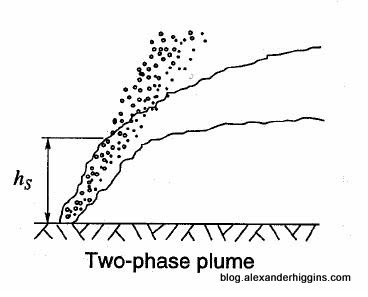
    Deepwater oil release - Buoyancy particle separation graph
    Deepwater oil release – Buoyancy particle separation graph

    Here is an image that captures the separation process
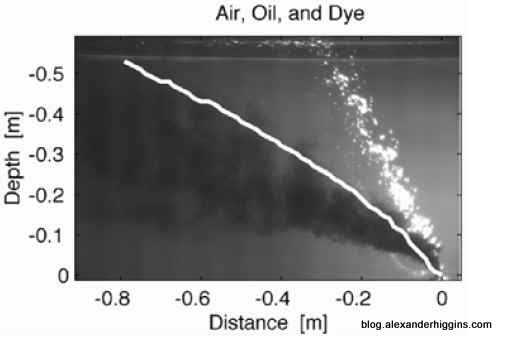
    Deepwater oil release - Buoyancy particle separation simulation
    Deepwater oil release – Buoyancy particle separation simulation
  4. Within the first 100 to 200 meters from the source of the release the the majority of the oil loses its buoyancy and stops rising. This majority of the oil remains submerged in an underwater plume that is then carried away by subsurface currents.
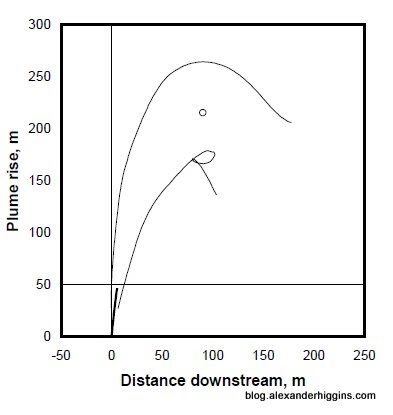
    Deepwater oil plumes lose buoyancy within the first few couple  hundred meters from release
    Deepwater oil plumes lose buoyancy within the first few couple hundred meters from release
  5. Oil plumes released from deepwater plumes can travel for long distances. It is uncertain if or where they will surface unless they are tracked.
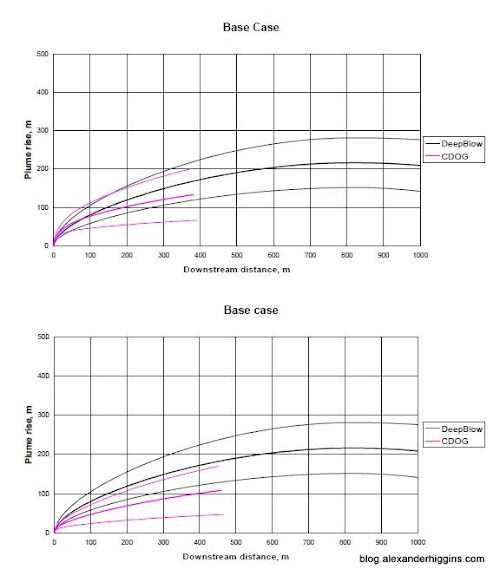
    Deepwater oil plumes travel for long distances
    Deepwater oil plumes travel for long distances
  6. A snippet from the study:

    Based on the models, the experimental studies described in Section 2 and, to a limited extent, the DeepSpill experiment described in Section 3, an accidental release of oil and/or natural gas obeys the following staged pattern. Near the release, oil, gas and entrained seawater rise as a coherent buoyant plume. A few meters above a point-source release, ambient conditions begin to affect the plume: crossflows cause the plume to deflect in the downstream direction and stratification retards the upward plume motion by entrainment of ambient seawater. For cases similar to the DeepSpill experiment, at a height of order 100 m, these ambient effects arrest the plume, and cause the entrained seawater and the dispersed phases to separate. The arrest takes the form of a completely bent over plume in the case of a strong crossflow, or a trap height and intrusion in the case of a stratification dominated plume. At this terminal level, there is rapid spreading, either by advection from the crossflow or gravitational collapse of the intrusion layer, and the oil is distributed over a wide area. Above this trapping zone, the oil rises as individual droplets.

Recently a NOAA expedition by the Gordon Hunter has confirmed that there are massive underwater lakes of oil floating beneath the surface of the Gulf of Mexico because as a top level whistle blower at the EPA points out the Federal Government has allowed BP to use toxic dispersants to save BP billions in fines.

7. Volume visualization

This report summarizes sensor data from AUV surveys conducted on June 2 – 3, when optical and chemical measurements indicated hydrocarbon detection in a plume-like feature below 1000 meters depth. Physical samples were acquired from this feature by ship and AUV sampling systems, and NOAA is managing shore-based laboratory analyses of these samples. When results from these analyses are available, more complete interpretation of the deep feature mapped by the AUV will be possible, including identification of chemical composition, concentration ranges, and source (wellhead or natural seafloor seep).
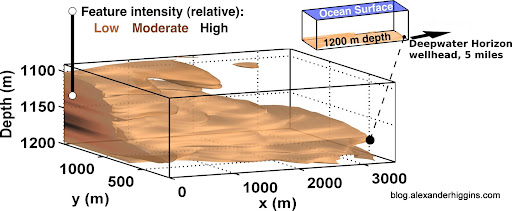
NOAA Confirms Huge Underwater Lakes Of Oil 1100 Meters Beneath  Surface Of Gulf

NOAA Confirms Huge Underwater Lakes Of Oil 1100 Meters Beneath Surface Of Gulf

The illustration above shows the deep plume-like feature mapped by the MBARI AUV Dorado on June 3, 2010. The data and methods used to describe this feature are summarized in this report. The brown hues of the feature represent the tea-like colors of Colored Dissolved Organic Matter (CDOM) because CDOM fluorometry was the basis for feature detection, data analysis and visualization.

As NOAA pointed out in the Brooks McCall report the oil trapped in these underwater lakes of oil will take months to surface.

Review of R/V Brooks McCall Data to Examine Subsurface Oil

Background

This report presents a preliminary analyses of data collected by the R/V Brooks McCall near the site of the Deepwater Horizon MC252 (DWH-MC252) wellhead between May 8 and May 25, 2010. During this timeframe the DWH-MC252 wellhead was releasing gas and oil in a turbulent mixture from the broken riser pipe attached to the well. Throughout the data collection period, a plume of oil and gas continually rose from the wellhead with some oil reaching the surface in about three hours. During the trip to the surface, it is expected that some of the oil dissolved in the water column and some formed droplets. The pressure that propelled the oil out of the wellhead was strong enough to cause some of the oil to form water-in-oil emulsion, or mousse.

Dispersing oil at depth, either naturally or chemically, has the effect of breaking up the oil into small droplets within the water column. Because dispersed oil droplets vary in both size and buoyancy, droplets of different sizes take different lengths of time to rise to the water’s surface. Very small droplets, less than about 100 μm in diameter, rise to the surface so slowly that ocean turbulence is likely strong enough to keep them mixed within the water column for at least several months.

So that means that even though there is no oil visible on the surface of the Gulf layers of toxic oil invisible to the naked eye will continue to wash up on Gulf beaches for months.

In fact an ABC 3 Wear TV Report confirms that while there is no longer visible oil washing up on Pensacola beach an invisible layer of toxic oil from the BP Gulf Oil Spill continues to cover Pensacola Beach.

PENSACOLA BEACH – There appears to be a lot less oil washing up on Pensacola Beach lately. But what about the oil you can’t see?

Dan Thomas joins us now with a Channel Three news investigation.

Retired Air Force Lieutenant Colonel Rip Kirby has spent the last few years studying Northwest Florida beaches.

He’s a Coastal Geologist with the University of South Florida.

When we first met him a few weeks ago, he showed us this… Sheets of oil under the sand, covered by the outgoing tide.

“Buried Tar and it’s constant.”
But lately, less oil has been washing up, and chances are if you dig today, you won’t see it.

Dan Thomas/dthomas@weartv.com: “The Escambia Health Department says if you can see oil, you should avoid contact with it and take a look out here on the Gulf Islands National Seashore there’s really no oil to be seen, that is until you use the UV light. When you shine it on the sand, just like a sheen on the water, it’s there.”

Through the filter of our camera, the sugar white sand becomes blue and what Kirby says is oil, becomes white.

Rip Kirby/USF Coastal Geologist: “So if you just literally, see the oil under neath it.”

Rip Kirby/USF Coastal Geologist: “This is from somebody’s tire track, it just fell off.”

Rip Kirby/USF Coastal Geologist: “The particular oil product that’s in here, was blown there.”

Rip Kirby/USF Coastal Geologist: “This is where people scrape their feet. See all the oil right there?”

The stuff was everywhere, a few inches into the sand, a light dusting on top and still more washing in.

Rip Kirby/USF Coastal Geologist: “There’s no contamination with the white light, only with the UV light. So during the day if some one came out here and sat in the sand, they’re going to get oil product on them just from sitting in the sand. The question becomes how long can they sit in the sand and have it touch their skin and have them lay on the sand with simply a cotton towel between them and this, breathing it before it becomes a toxic problem for them to deal with 20 years from now when they have some kind of cancer? The answer to that is, I don’t know.”

Rip Kirby/USF Coastal Geologist: “We haven’t seen and I’ve been looking for it for six weeks now and I have not seen a report that tells me the chemical constituents of the oil product that’s in the beach sand.”

We put a call in to BP… They say they’re working on getting us that report.
So far we haven’t seen it either.

Monday, August 2, 2010

WISE MARINE TOXICOLOGY LAB/GULF MISSION

http://www.usm. maine.edu/ toxicology/ gulf/index. php


Research Vessel The Odyssey

On April 20 of this year, the Deepwater Horizon oil rig exploded resulting in an uncontrolled release of oil into the ocean. Estimates now indicate that 1.5 million to 4.2 million gallons continue to flood into the Gulf on a daily basis totaling between 85.5 million and 239 million gallons with no end in sight. Superimposed on the threat of the oil, is the already more than one million gallons of toxic chemical dispersants that British Petroleum (BP) dumped into the Gulf to try and breakup the oil. These chemicals are being used in unprecedented amounts and in untested ways.

One major concern is the impact of this crisis on wildlife in the Gulf of Mexico. Marine mammals are a particular concern because they serve as sentinels for human health and because they are key species for both the ocean ecosystem and coastal economies. Marine mammals are at risk in this crisis. For example, there is a resident population of about 1,600 sperm whales in the Gulf of Mexico. This population is endangered, as all sperm whales are, but this population is considered to be at particular risk because the size of the group is so small. Losing even a few whales will have dramatic population effects because individual whales take a long time to reach sexual maturity and then only produce a few calves over their lifetimes. The Gulf Oil spill is a specific threat to these sperm whales, because they occupy deeper waters and thus are much closer to the greatest amount of oil. Moreover, studies show that prior to the explosion, many sperm whales spent a lot of time near the Deepwater Horizon oil rig. In fact, a dead sperm whale has recently been discovered near the oil spill though the cause of death has not yet been reported.

Oil can have immediate and long term impacts on whales and other marine mammals. Marine mammals breathe air and, thus, if they surface to breathe in an oil slick, they can inhale the oil resulting in respiratory issues. Even if they do not surface within the slick itself, they may inhale sufficient amounts of the strong fumes emanating from the slick that can render them unconscious and cause them to drown. Oil can contaminate their food, and if they eat it, they can experience digestive disorders and immune system effects. Oil can also have long term effects such as damaging their DNA. If this occurs, it can impair the whales’ ability to reproduce, thus, reducing the number of calves born. The impacts of oil on whale populations were seen after the Exxon Valdez oil spill. That oil decimated the killer whale population, reducing it by 40%. Experts predict that this population will ultimately go extinct.

The effects of dispersants on whales are unknown and have not been studied. They have also never been released into the environment in such massive quantities.

Toxicology is the study of how chemicals (like oil and chemical dispersants) poison people, plants and animals. Currently, there are no focused toxicology efforts to assess the impact of the oil crisis in the Gulf on whales and no efforts to conduct a similar study in Atlantic whales now before the oil arrives. Moreover, no government rapid response funds for university researchers have been allocated for toxicology studies. In fact, remarkably, many of the programs specifically exclude using these funds for toxicology studies. It is essential that we conduct whale toxicology studies in both the Atlantic Ocean (before the oil arrives and then again after it does) and in the Gulf of Mexico in both oiled and non-oiled areas. It will be up to us, the people, to fund these studies.

[CLICK ON LINK TO READ THE WHOLE ARTICLE]

OCEAN ALLIANCE/ODYSSEY REPORT

www.oceanalliance.org/

SEE ALSO the Facebook group "A Race To Save Our Oceans" for up to the minute postings from the crew of the Odyssey...

Ocean Alliance Releases Voyage of the Odyssey Report

6/24/2010

The Voyage of the Odyssey Report is the scientific end-product of Ocean Alliance’s 5-year, round the world research expedition during which scientists and crew collected biopsy samples and other data from almost 1,000 sperm whales globally.

Conducted aboard Ocean Alliance’s research vessel Odyssey, a 93-foot ketch motor-sailor, the expedition collected research data from sperm whales while providing formal and informal education and conservation programs in the 118 ports in 22 countries that the Odyssey and crew visited.

Departing from San Diego and traveling 87,000 nautical miles before its return to Boston, the Voyage of the Odyssey was a remarkably successful expedition to collect the first-ever baseline data set on toxic contaminants throughout the world’s oceans by studying the sperm whale, a cosmopolitan whale species that sits atop the oceanic food chain.

To access the Executive Summary, click below:

http://www.oceanalliance.org/documents/OAVoyageoftheOdyssey-ExecutiveSummary.pdf